domingo, 22 de junho de 2008

How to Win at Poker—and at Business

In "BusinessWeek":

The skills that bring you success while playing cards can also help you know when to fold 'em or hold 'em at the negotiating table.

Deepak Thadani learned how to play poker during a trip to Atlantic City in 2004, a few years after he launched a high-end network security company in Woodside, N.Y. He soon discovered that many of his clients—CEOs and CFOs of large New York companies—were also aspiring card sharps. So he organized a monthly game. "Poker's like the new golf," says Thadani. "People get together at the poker table, they play, and they build relationships."

He picked up on the intricacies of the game quickly. In 2006 his prize for winning a $600 buy-in tournament was a free seat at the $10,000 buy-in World Series of Poker main event in Las Vegas. He didn't get very far in that, the mother of all poker tournaments. But playing alongside the seasoned pros helped Thadani discover that people who are successful in poker have a lot in common with people who are successful in business. "It's not the hands that you're dealt; it's the way you play them that separates the regulars from the pros," he says. "Just like in business."

Poker professionals, too, can't help but notice the overlap. In the past decade, as poker has been inundated with amateurs who learned to play from televised tournaments and online gambling sites, many of the most successful no-names have had backgrounds in business. The list of recent World Series of Poker main event champions includes a TV producer, a patent attorney, an accountant, an investment banker, and a carpet manufacturer.

People Skills

"The most successful people in the business world, what they do best is manage people, or understand people, or know how to relate and deal with people. And that's what poker is all about—people," says Tom McEvoy, a veteran player who won the main event in 1983 not long after giving up his first aspiration, accounting, for a career in poker.

Acting persuasively, reading opponents' motives, and handling the subtleties of a monetary transaction are skills the poker greats work tirelessly to hone. These same skills are essential for negotiating a business deal.

In essence, each hand you are dealt in poker is like a product whose value you are trying sell to the rest of the table by placing bets, raising them, and calling other players' bets. Your hand frequently won't be the most valuable on the table. But by piecing together the limited information you have about your opponents and their hands—one might look nervous, one might be talking a lot, one might have a history of folding—you may be able to win with a well-timed and persuasive bluff.

Of course, winning card players aren't always bluffing. Sometimes they have the best hand possible—"the nuts," in poker lingo—and have to decide exactly how much they can bet without scaring off other players. "Figuring out how best to price things to give yourself maximum value is something that's exactly what you do in a poker hand, and it's exactly what you do when you're trying to sell something in business," says poker pro Daniel Negreanu. "If I feel like I've made an offer, and I feel like I can get more on it, I'll continue to push until I feel [the other guy] is at his breaking point."

Incomplete Information

When it's time to bluff, or to call an opponent on their bluff, it's important to know who you're dealing with. Every morsel of information you can pick up—their posture, how they move their eyes, where they put their hands, what they say or don't say—can be a clue to what kind of poker hand they have. "When I'm sitting at the table even for 30 minutes with people I don't know, I can tell a lot about them," says poker pro Chad Brown. "Poker is about incomplete information, so you take that incomplete information and you have to make an analysis of how you want to play against each of those players."

But in theory at least, there's one big difference: In a business deal, often everyone goes home a winner, having gotten at least part of what he or she wanted; in poker, there's one winner, and the potential to lose big is great.

Poker pro Barry Greenstein knows this difference first-hand. Greenstein was one of the first software designers at Symantec (SYMC) when it was founded in the early 1980s, and he played a role in negotiating some 20 of the company's acquisitions through the early '90s—including that of Norton Utilities, Symantec's biggest coup. The pitch to Norton, he remembers, was win-win: "'If you come along with us, we're so much better at sales and marketing that you will sell more of your product and make more money that way.' For us, we needed to make these acquisitions because when you go public, investors want to see you have a diverse product line."

By contrast, when he's playing poker, says Greenstein, "generally I'm negotiating, so it's good for me and bad for the other guy."

See BusinessWeek.com's slide show for negotiating lessons from poker pros.

domingo, 8 de junho de 2008

Oil Prices ... Jump Past $138

In "NYTimes.com":

The rise in oil prices turned into a stampede on Friday with futures jumping a staggering $11 a barrel to set a record above $138 a barrel. The unprecedented surge came as the dollar fell sharply against the euro and a senior Israeli politician once again raised the possibility of an attack against Iran.

...

Even as uncertainties abound about the fundamentals of the energy market, geopolitical tensions in the Middle East regained center stage after Israel’s transportation minister and a deputy prime minister, Shaul Mofaz, said Friday that an attack on Iran’s nuclear sites looked “unavoidable” if Iran did not abandon its nuclear program.

Iran is the second-largest oil producer within the OPEC cartel and exports nearly two million barrels a day. Because the world has few supplies to spare, any interruptions in Iran’s exports could push prices to higher levels. The world currently has about three million barrels a day of spare capacity, and consumes 86 million barrels a day of oil.

...

One view gaining ground is that the commodity market is caught in a speculative bubble akin to the recent housing bubble or the technology bubble of the late 1990s. That theory was raised by politicians in Washington and by OPEC producers, who blame speculators for the staggering oil rally. Speaking before Congress recently, George Soros, a prominent hedge fund investor, said the current oil markets presented some characteristics of a bubble.

“I find commodity index buying eerily reminiscent of a similar craze for portfolio insurance, which led to the stock market crash of 1987,” Mr. Soros said this week. But he cautioned that an oil market crash was not imminent. “The danger currently comes from the other direction. The rise in oil prices aggravates the prospects for a recession.”

But many analysts say that fundamentals, not speculation, are driving prices.

“I don’t know how else to say it, this is not a bubble,” Jan Stuart, global oil economist at UBS, said. “I think this is real. There is a whole bunch of commercial buyers out there who are spooked and are buying. You are an airline, right now, you’re scared. I don’t see who would buy at these prices unless they need to.”

Jeffrey Harris, the chief economist at the Commodity Futures Trading Commission, who was speaking before a Senate committee last month, said he saw no evidence of a speculative bubble in commodities. Instead, Mr. Harris pointed to a confluence of trends that has contributed to the oil price rally, including a weak dollar, strong energy demand from emerging economies, and political tensions in oil-producing countries.

“Simply put, the economic data shows that overall commodity price levels, including agricultural commodity and energy futures prices, are being driven by powerful fundamental economic forces and the laws of supply and demand,” Mr. Harris said. “Together these fundamental economic factors have formed a ‘perfect storm’ that is causing significant upward pressures on futures prices across the board.”


ver: http://www.nytimes.com/2008/06/07/business/07oil.html?th&emc=th

terça-feira, 3 de junho de 2008

Como são formados os preços dos combustíveis

In "Jornal de Negócios":

A Autoridade da Concorrência (AdC) revelou como são compostos os preços dos combustíveis no mercado nacional. A maior fatia corresponde a impostos, como já foi amplamente noticiado. É a distribuição e os vendedores que ficam com a menor fatia.

No primeiro quadrimestre de 2008 a média do preço da gasolina fixou-se nos 1,393 euros. Deste total, quase 60% foi directo aos cobres do Estado (0,825 euros). As refinarias receberam dos operadores 31,4% do valor total, ou seja, 0,438 euros.

Os vendedores representam 7,97% do preço, ou seja, 0,111 euros e os distribuidores correspondem a 1,44% do valor total da gasolina (ver quadro em baixo), segundo o relatório da AdC.

No caso do gasóleo, o valor médio dos quatro trimestres ascendeu a 1,229 euros com os impostos a corresponder a 46,9% do total (0,577 euros).

Os operadores pagaram 42,2% às refinarias e a distribuição correspondeu 1,5% do preço. Os vendedores pesam 9,3% no peso final do gasóleo.

Gasolina 95 octanas*
Gasóleo*
ISP 0,583 41,85% 0,364 29,6%
IVA 0,242 17,37% 0,213 17,3%
Venda a retalho 0,111 7,97% 0,114 9,3%
Distribuição 0,02 1,44% 0,019 1,5%
Refinarias 0,438 31,4% 0,519 42,2%
Total 1,393 100% 1,229 100%
* preços médios de venda nos primeiros quatro meses do ano
Fonte: Autoridade da Concorrência

sexta-feira, 30 de maio de 2008

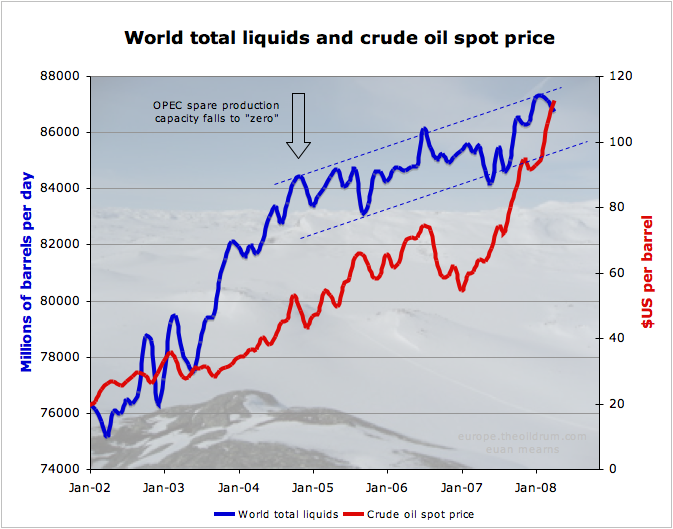
Why oil costs over $120 per barrel

In "The Oil Drum Europe":


Global Total Liquids production and oil price, January 2002 to present. Production data from the IEA, data files supplied by Rembrandt Koppelaar. Monthly average WTI oil prices from Economagic.
...

The principal reason for current high oil price is the proximity of a peak in global oil production. Politicians must understand this and then grasp that natural gas and coal supplies will follow oil down by mid century. Reducing taxes on energy consumption right now is the wrong thing to do. Taxation structure needs to be adjusted to oblige energy producing companies to re-invest wind fall profits in alternative energy sources on a truly massive scale.

Energy efficiency should be the guiding beacon of all policy decisions and this must apply equally to energy production and energy consumption.

...

Oil is still cheap


At $2 per liter bottled spring water costs $318 per barrel.

Oil is still very cheap. Bottled spring water at $2 per litre works out at $318 per barrel. Oil is fundamental to our lives for transportation and a myriad products ranging from plastic to pesticides. Unlike spring water, oil is finite and costs significantly more to find and produce. The price of oil will continue to rise until the world as a whole decides it can do with less or until meaningful volumes of energy substitution take root.

Ver artigo completo em: http://europe.theoildrum.com/node/4007#more

P.S. Grafico do crude junto com o dolar:


crude_159

Ver: http://www.thinkfn.com/forum/viewtopic.php?t=14108&postdays=0&postorder=asc&start=100

quarta-feira, 28 de maio de 2008

Ciclo Económico

In "knoow.net":

Conceito de Ciclo Económico

Os Ciclos Económicos correspondem a oscilações do produto, do rendimento e do emprego, cuja duração corresponde geralmente a um período de 2 a 10 anos e são caracterizados pela expansão ou pela contração generalizada na maioria dos sectores económicos.

Fases dos Ciclos Económicos

Cada Ciclo Económico apresenta duas fases principais: a expansão e a recessão. Os pontos de viragem dos ciclos são designados por picos (pontos de viragem de uma expansão para uma recessão) e por fundos (pontos de viragem de uma recessão para uma expansão).


Sobre este tema consultar:

http://www.knoow.net/cienceconempr/economia/cicloeconomico.htm

http://www.eumed.net/tesis/jass/22.htm

http://libertyzine.blogspot.com/2007/02/teoria-austraca-dos-ciclos-econmicos.html

http://www.geocities.com/projetoperiferia2/secC7.htm

http://econpapers.repec.org/paper/wpawuwpma/0402010.htm

https://repositorio.iscte.pt/handle/10071/496

terça-feira, 27 de maio de 2008

BCE “versus” Federal Reserve: diferenças no passado; diferenças no presente

In "Jornal de Negócios":

Em 1922, uma hiperinflação impressionante atacou a economia alemã, acabada de sair de uma guerra mundial, deixando marcas que ainda hoje se podem perceber. O cinema e as artes retrataram cenas desse enorme drama que ainda actualmente constitui uma amargura instalada na profundidade e na complexidade da alma germânica.

Trata-se de um facto histórico que de forma alguma um verdadeiro alemão esquece e que jamais deixará de fazer esforços para que se não repita e cuja imagem célebre é a do filme, creio que de Charlot, mostrando um empregado da construção civil a dirigir-se ao balcão de venda do passe social e a pagar o mesmo com um “monte de notas de banco” transportadas num carrinho de mão.

Por exigência germânica e face ao peso desse País na União Monetária Europeia o principal objectivo do Banco Central Europeu, que conseguiu, “malgré tout”, passando por cima do venerando Deutsche Bundesbank, ser o Banco Central da União em que a Alemanha se integrou e por tudo isso se instalou em Frankfurt foi o de estabilidade dos preços.

Os alemães consentiram uma moeda única, desde que esta se pautasse pelas regras por que se pautava o “deutsche mark” e todos os parceiros obedecessem a “um código de convergência económica,” respeitando-o, sem dúvidas existenciais e com penalidades pesadas. (*)

Em 1929, nos EUA, teve-se uma prolongada e alastrada Grande Depressão, de características contrárias às da hiperinflação alemã, em que o desemprego e a recessão desembocaram numa loucura de luta pelo trabalho, elevação do valor da moeda, desinvestimento, estagnação e queda da economia, um rol de situações de miséria e de convite ao vício e às experiências “gangsterianas”, que só a “forte alma americana” conseguiu diluir, sem deixar de exportar o que de pior teve a crise, para o resto do mundo, especialmente a Europa.

Numa situação de queda brusca da liquidez e do volume de moeda, o Federal atacou o problema condicionando o preço (taxa de juro) e a oferta de moeda. Como se sabe, o FRB foi mais tarde acusado, por isso mesmo, de não ter atacado as causas do fenómeno (a crise de liquidez) e de ter contribuído antes para o agravar, com uma “incorrecta” e inoportuna “tight money policy”. (**)

O Federal Reserve System tem hoje como objectivo, além da estabilidade de preços, o crescimento económico equilibrado.

Será que nestas duas áreas geográficas o passado e as suas principais crises condicionaram a sua propensão para uma (diferente) valorização das medidas de política a adoptar em crises como a actual?

Na actualidade, Alan Greenspan (***), ex-presidente do FED de New York, refere os êxitos do Banco Central Europeu (e do seu presidente, Jean-Claude Trichet). Após comentar a sua surpresa pela capacidade de convergência dos 13 membros iniciais da nova área monetária, salienta o contraste entre a “única obrigação do BCE”, a estabilidade de preços, para uma região que produz mais de 1/5 do PIB mundial e o objectivo mais lato, americano, de estabilidade de preços com procura de um crescimento equilibrado.

O que mais o impressiona parece ser o facto de o Tratado de Maastricht e a figura do Pacto de Estabilidade e Crescimento, ao subtraírem a política monetária ao controlo dos governos e restringir o nível dos défices orçamentais, terem criado, ao fim e ao cabo, dispositivos automáticos de ajustamento de mercado.

A verdade é que o euro já conseguiu, segundo ele, ocupar 25% de lugar no cabaz das moedas de reserva cambial, relegando o dólar para 66% (Setembro de 2006).

O abaixamento das taxas de juro no passado recente foi a consequência desta subida de importância do euro nas reservas. O mesmo sucedera já com o dólar, consentindo um crescimento da economia americana.

Contudo esta mesma causa, agora, leva a estados de alma (e de opinião) diferentes. Enquanto que do lado de lá do Atlântico e por causa da “crise de liquidez” a FED não quer correr de novo riscos de ser acusada de dificultar, e tem produzido nova liquidez e baixado taxas de juro, o seu colega europeu não pára de as fazer subir, com receio de uns 3,6% registados na taxa de inflação homóloga sob controle do BCE e apesar da recomendação recente de Michael Deppler, director do Departamento Europeu do FMI, que na sua apresentação, em Frankfurt, das “Perspectivas Regionais para a Europa” (IV) recomendava vivamente o corte dos juros.

Em reunião do BCE, parece ter havido mesmo quem apontasse a anormal subida de preços do petróleo, como algo que faz lembrar um processo de estagflação, e que de modo algum recomenda facilidades no preço do dinheiro.

Ao mesmo tempo, porém, na Europa da União, mesmo que não necessariamente no espaço do euro, com o argumento de que mais importante é salvar o sistema bancário e auxiliar a confiança na banca, procedeu-se à “nacionalização” (temporária?) do quase falido Northern Rock e projectou-se injectar liquidez em volume substancial para também permitir ao sistema suportar uma situação de “crise de liquidez” na Europa financeira (nos EUA segurou-se o atribulado Bear Sterns e injectou-se liquidez criando novas “facilities”).

Será que pura e simplesmente a coerência não tem de ser encontrada entre o procedimento aqui e ali, adoptando-se as soluções conforme a importância dos receios ou/e conforme as marcas históricas deixadas pelas “outras crises” do lado de lá e do lado de cá do oceano?

Pelo seu interesse e graça referimos ainda, sobre o mesmo assunto, a opinião do professor de Harvard, Ken Rogoff (antigo economista-chefe do FMI, (V) que disse que muitos pensam que “o mundo termina ou em fogo ou em gelo”. O Federal parece temer e pensar que o mundo terminará em fogo; o BCE teme o gelo.

(*) Note-se que após a serena e “consentida” reunificação alemã pagou ela própria, como se esperava, os custos de uma divergência pesada, que a Europa, com condescendência e boa memória política, também consentiu e fez por esquecer.

(**) Sobre esta acusação, dizia Paul Meek (professor do curso para banqueiros centrais da FED nos anos 90, no mandato de Paul Volcker), que se tratava de uma política que poderia ser discutida durante muito tempo e sempre se encontrariam argumentos a favor e contra.

(***) “A ERA DA TURBULÊNCIA”, Alan Greenspan (no Prefácio).

(IV) in “Jornal de Negócios”, de 22 de Abril de 2008. “FMI diz que Trichet terá de cortar juros nos próximos seis meses; responsáveis do BCE discordam da avaliação e admitem ter de subir juros.”

(V ) “Economist”; March 22nd, 2008: “Central banks, a dangerous divergence” (págs. 77).

Relator da ONU diz que biocombustíveis são um crime contra a humanidade

In "BBC NEWS":


Barley (Image: National Non-Food Crops Centre)
Food prices have risen as more land is used to produce biofuels
A United Nations expert has condemned the growing use of crops to produce biofuels as a replacement for petrol as a crime against humanity.

The UN special rapporteur on the right to food, Jean Ziegler, said he feared biofuels would bring more hunger.

The growth in the production of biofuels has helped to push the price of some crops to record levels.

Mr Ziegler's remarks, made at the UN headquarters in New York, are clearly designed to grab attention.

He complained of an ill-conceived dash to convert foodstuffs such as maize and sugar into fuel, which created a recipe for disaster.

Food price rises

It was, he said, a crime against humanity to divert arable land to the production of crops which are then burned for fuel.

He called for a five-year ban on the practice.

Within that time, according to Mr Ziegler, technological advances would enable the use of agricultural waste, such as corn cobs and banana leaves, rather than crops themselves to produce fuel.

The growth in the production of biofuels has been driven, in part, by the desire to find less environmentally-damaging alternatives to oil.

The United States is also keen to reduce its reliance on oil imported from politically unstable regions.

But the trend has contributed to a sharp rise in food prices as farmers, particularly in the US, switch production from wheat and soya to corn, which is then turned into ethanol.

Mr Ziegler is not alone in warning of the problem.

The IMF last week voiced concern that the increasing global reliance on grain as a source of fuel could have serious implications for the world's poor.


Para mais informações relacionadas com os biocombustíveis consultar:

http://en.wikipedia.org/wiki/Biofuel

http://news.cnet.com/8301-11128_3-9933355-54.html?tag=bl

http://jn.sapo.pt/2008/05/23/opiniao/os_biofuel_crisealimentar_mundial.html

http://www.alternative-energy-news.info/technology/biofuels/

http://www.nytimes.com/2008/02/08/science/earth/08wbiofuels.html

http://caldeiraodebolsa.jornaldenegocios.pt/viewtopic.php?t=62701&highlight=biocombustiveis

http://pt.wikipedia.org/wiki/Biodiesel

quinta-feira, 22 de maio de 2008

Portugal é o país da UE com mais desigualdades na distribuição de rendimentos

In "PUBLICO.PT":

Portugal foi hoje apontado em Bruxelas como o Estado-membro com maior disparidade na repartição dos rendimentos, ultrapassando mesmo os Estados Unidos nos indicadores de desigualdade. O Relatório Sobre a Situação Social na União Europeia (UE) em 2007 conclui, no entanto, que os rendimentos se repartem mais uniformemente nos Estados-membros do que nos Estados Unidos, à excepção de Portugal.
O relatório é o principal instrumento que a Comissão Europeia utiliza para acompanhar as evoluções sociais nos diferentes países europeus. Os indicadores de distribuição dos rendimentos mostram que os países mais igualitários na distribuição dos rendimentos são os nórdicos, nomeadamente a Suécia e Dinamarca.
"Portugal distingue-se como sendo o país onde a repartição é a mais desigual", salienta o documento que revela não haver qualquer correlação entre a igualdade de rendimentos e o nível de resultados económicos.
Contudo, se forem comparados os coeficientes de igualdade de rendimentos dos Estados-membros com o respectivo PIB (Produto Interno Bruto) por habitante constata-se que os países como um PIB mais elevado são, na sua generalidade, os mais igualitários.


P.S.: Desigualdade diminui após forte correção de dados pelo INE

In "Jornal de Negócios":

O Instituto Nacional de Estatística (INE) procedeu a uma acentuada revisão dos números sobre a desigualdade na repartição do rendimento. Embora não tenha alterado a posição de Portugal como campeão do fenómeno na União Europeia, a alteração fez com que o primeiro ano de governação de José Sócrates - 2005 - deixasse de poder ser apontado como o período com maior fosso entre pobres e ricos de que há registo.
O pico das desigualdades, medidas pela distância que separa o rendimento dos 20% mais ricos dos 20% mais pobres, situa-se agora em 2003, altura em que o País era dirigido pelo governo social-democrata de Durão Barroso.
A evolução da distribuição do rendimento voltou a agitar o debate político, no rescaldo da divulgação de um estudo coordenado por Bruto da Costa, presidente do Conselho Económico e Social, noticiado pelo jornal "Público", em que se conclui que metade das famílias portugueses viveram, entre 1995 e 2000, pelo menos um ano em situação de pobreza.

P.S.2.:

In "nossomoscapazes.blogspot.com":

...

...

O indicador das disparidades de rendimento compara os 20 por cento mais ricos com os 20 por cento mais pobres. Corrigidos os dados, descobre-se que a amplitude das disparidades não é de 8,2 vezes, como tinha sido anunciado, mas de 6,9.

Observando o gráfico, verifica-se que, após um pico em 1995, se assiste a um decréscimo, de melhoria, acentuado das disparidades de rendimento com os governos de António Guterres e volta a melhorar com o José Socrates . Mas o indicador volta a subir e a piorar para os portugueses com o Governo de Durão Barroso em 2002 e 2003, no qual pontificava a ministra das Finanças Manuela Ferreira Leite, que subitamente agora aparece apoquentada com “preocupações sociais”.

segunda-feira, 12 de maio de 2008

Preço internacional do arroz subiu 76% em quatro meses

In "Jornal de Negócios":

Entre Dezembro de 2007 e Abril de 2008 os preços do arroz nos mercados internacionais dispararam 76%, segundo o índice da FAO para o cereal. A organização da ONU para a agricultura e alimentação disse hoje que a produção mundial vai aumentar, mas os preços continuarão altos até, pelos menos, o terceiro trimestre de 2008. 

Em comunicado hoje divulgado, a FAO – Food and Agriculture Organization, instituição da Organização das Nações Unidas (ONU), defende que os preços internacionais deverão "manter-se a níveis relativamente altos", enquanto prevê que os ‘stocks’ dos exportadores devam sofrer uma redução drástica.

"Para que os preços caiam, condições climatéricas favoráveis deverão prevalecer nos próximos meses e os governos deverão aliviar as restrições sobre as exportações", escreve a FAO. "Mesmo assim, é improvável que os preços do arroz regressem aos níveis de 2007, já que os produtores têm de pagar muito mais pelos fertilizantes, pesticidas e combustível".

O problema não é a produção, diz a FAO, que este ano até deve aumentar e atingir mesmo níveis recorde na Ásia, África e América Latina. A produção de arroz "poderá aumentar em cerca de 2,3% e atingir um novo recorde de 666 milhões de toneladas", segundo a previsão inicial da organização, hoje anunciada por Concepcion Calpe, especialista naquele cereal, citada no comunicado.

A produção mundial até poderá ser mais elevada "se apelos e incentivos recentes para aumentar a actividade levar a áreas de cultura maiores". A previsão da FAO é que na Ásia, a produção ultrapasse o "benchmark" de 600 milhões de toneladas, para atingir os 605 milhões de toneladas. Em África, o aumento deverá ser de 3,6%, para 23,2 milhões de toneladas em 2008. E na América Latina e Caraíbas, a progressão deverá ser de 7,4%, para 26,2 milhões de toneladas em 2008.  As "perspectivas de produção, contudo, são negativas para a Austrália, os EUA e a Europa".

Os problemas, que deverão manter os preços do arroz altos durante mais dois trimestres, é que, por um lado, as colheitas de arroz da campanha deste ano já só serão feitas no final de 2008. E, por outro lado, a situação em Myanmar (antiga Birmânia) veio piorar a situação.

O efeito "Myanmar"

Segundo a FAO o ciclone que abalou recentemente Myanmar "pode piorar a previsão actual de produção mundial de arroz". O ciclone atingiu o país quando os agricultores estavam a apanhar a colheita da época seca, que vale cerca de 20% da produção anual. Agora estão áreas inteiras de produção de arroz estão inundadas e vários armazéns e reservas do cereal estão destruídas. Na capital, em Rangoon, os preços do arroz já aumentaram 50%.

O que quer dizer, explica a organização agrícola e alimentar da ONU, que Myanmar irá voltar-se agora para os seus países vizinhos, como a Tailândia e o Vietname para importar arroz. O que irá pressionar ainda mais os preços mundiais do cereal.

Apenas três exportadores sem restrições

Actualmente, apenas a Tailândia, o Paquistão e os Estados Unidos da América (EUA), entre os grandes vendedores mundiais, estão a exportar arroz sem restrições.  

Numa tentativa de evitar a escassez de alimentação no seu próprio território, muitos exportadores de arroz têm imposto interdições, impostos o tectos à saída do cereal para outros países.

Há ainda outras restrições, "adormecidas" durante duas décadas, que a FAO acredita que foram agora enfatizadas: investimento reduzido na agricultura, especialmente na questão do regadio, financiamento baixo na investigação e desenvolvimento agrícola, problemas ambientais, produção estagnada e migração de áreas rurais para as cidades.

Petróleo atinge novo recorde em Nova Iorque e cai a seguir

In "Jornal de Negócios":

Os preços do West Texas Intermediate, crude de referência dos Estados Unidos, atingiram momentaneamente um novo máximo histórico, nos 126,40 dólares por barril, tendo em seguida perdido terreno, com alguns investidores a comprarem devido a receios de uma menor oferta e outros a venderem em resposta à valorização do dólar, refere a "Canadian Business".

Esta foi a sexta sessão consecutiva de recordes para o WTI, transaccionado no mercado nova-iorquino. O Brent do Mar do Norte, "benchmark" para a Europa e negociado em Londres, atingiu o valor mais alto de sempre na passada sexta-feira, nos 125,90 dólares por barril.

Neste momento, as cotações cedem terreno, com o WTI [Cot] a perder 0,41% para 125,44 dólares e o Brent [Cot] a cair 1,50% para 123,52 dólares.

Os principais factores que têm sustentado o petróleo são a fragilidade da nota verde e os crescentes receios de quebras de produção de crude no México, na Rússia e outros países. Na Nigéria, a oferta foi reduzida para cerca de metade devido aos ataques a instalações petrolíferas por parte do movimento rebelde de defesa do Delta do Níger.

A Goldman Sachs referiu na quinta-feira passada, numa nota de "research", que os preços poderão rondar os 150-200 dólares por barril nos próximos seis meses a dois anos.

O presidente da OPEP, Chakib Khelil, e o ministro iraniano do Petróleo, Gholamhossein Nozari, também alertaram para o facto de o crude poder chegar aos 200 dólares, não por via de uma menor oferta nos mercados mundiais mas sim pela desvalorização do dólar.

A recuperação da moeda norte-americana face ao euro na sessão de hoje constitui um bom motivo para os investidores estarem de momento a vender petróleo, o que cair os preços. Um dólar mais forte torna as "commodities" menos atractivas para os investidores como um refúgio contra a inflação, e torna o petróleo mais caro para os investidores estrangeiros, salienta a "Canadian Business".

domingo, 4 de maio de 2008

Buffett Says U.S. Dollar to Remain Weak Versus Other Currencies

In "bloomberg.com":

May 3 (Bloomberg) -- Billionaire Warren Buffett, the chief executive officer of Berkshire Hathaway Inc., said he thought the U.S. dollar will keep weakening against other currencies.

If Buffett, ``landed from Mars today with a billion of Mars dollars, or whatever they call them on Mars, and I was thinking about where to put my money,'' he wouldn't put it all in the U.S. currency, he said today during a question-and-answer session at Omaha, Nebraska-based Berkshire's annual shareholder meeting.

Buffett, 77, has made investments with the assumption the U.S. dollar will weaken since at least 2002, first with direct bets against the currency, and later with his first purchase of a non-U.S. company.

``The U.S. is going to continue to follow policies that make the dollar weaker,'' Buffett said.

Americans' preference for foreign goods causes the country to send about $2 billion in ``IOUs'' and assets overseas every day, putting pressure on the dollar, Buffett said in his annual letter to shareholders.

He also said today that he feels ``no need'' to hedge against currency risk when buying large companies outside the U.S.

PETROBRAS - Petroleo Brasileiro SA

In "bloomberg.com":

PETR4:BS
Petroleo Brasileiro SA
Industry: Oil Comp-Integrated

05/02    Sao Paulo  Currency: BRL


Price 43.000 Change 0.800 % Change 1.896 Bid N.A. Ask N.A. Open   44.200
Volume N.A. High 44.200 Low 42.450 52-Wk High 45.445 (11/09/07) 52-Wk Low 21.810 (08/16/07) 1-Yr
Return
91.667

FUNDAMENTALS


Shares
(Millions)
3,700.729
Market Cap
(Millions)
420,459.500
Earnings 2.452 Price/
Earnings
 
17.539
Relative
P/E
1.040
ROE 20.353
Last Dividend
Reported
  
0.026 Regular Cash
Dividend Yield
(Trailing 12mo.)
      
1.765
Rel. Dividend
Yield
     
0.695
90-Day
Volatility
47.268
Beta
vs. IBOV
       
1.015

Price for PETR4:BSSECTOR COMPARATIVE RETURNS


Chart the Performance of PETR4:BS PETR4:BS IBOV:IND

COMPANY PROFILE


Petroleo Brasileiro S.A. - Petrobras explores for and produces oil and natural gas. The Company refines, markets, and supplies oil products. Petrobras operates oil tankers, distribution pipelines, marine, river and lake terminals, thermal power plants, fertilizer plants, and petrochemical units. The Company operates in South America and elsewhere around the world.

Petrobras Finds Make Stock Most Expensive Oil Company:

May 2 (Bloomberg) -- The biggest oil discovery in the Western hemisphere in three decades and speculation about an even larger deposit turned Petroleo Brasileiro SA into the world's most expensive energy producer.

Petrobras, as the company is known, trades at 17.2 times profits after rallying 87 percent in the past year. The shares are twice as expensive as Russia's OAS Lukoil and Royal Dutch Shell Plc of the Netherlands, and 50 percent more than Exxon Mobil Corp., as investors focus on the Rio de Janeiro-based company's oil finds rather than its falling profits.

``You just never know when they're going to make the next announcement,'' said William Landers, who oversees $8.2 billion in Latin American stocks at BlackRock Inc. in Plainsboro, New Jersey, including shares of Petrobras. ``You don't want to be on the wrong side of that trade.''

The Brazilian government's controlling stake in Petrobras may add to the stock's allure on speculation the company will get favorable treatment in exploiting oil. President Luiz Inacio Lula da Silva's administration pulled 41 exploration licenses from an auction after Petrobras found the Tupi oil field Nov. 8, a discovery that caused the stock to jump 14 percent, the biggest rise in nine years. Tupi, 155 miles (250 kilometers) off Brazil's coast, may have 8 billion barrels of recoverable oil.

Petrobras shares rose another 5.6 percent on April 14 after the head of Brazil's oil agency said the offshore Carioca prospect may hold the equivalent of 33 billion barrels of crude, large enough to be the world's third-biggest field. Chief Executive Officer Jose Sergio Gabrielli said later Petrobras is still exploring to determine Caricoa's size.

Bovespa's Gain

The oil company helped lead Brazil's Bovespa to a 6.3 percent jump on April 30, making it the world's best-performing equity index this year among the 20 biggest markets, after Standard & Poor's assigned the country an investment grade credit rating. Petrobras added 1.9 percent to 43 reais today as the Bovespa increased 2.2 percent.

Petrobras, now the world's ninth-biggest company, with a market value of $248.3 billion, is still half the size of Exxon, the largest oil producer.

Fourth-quarter profit at Petrobras declined about 3 percent as costs increased faster than sales. The company produced an average 2.34 million barrels of oil, natural gas and natural-gas liquids a day in March, down from 2.35 million barrels a day the month before.

Petrobras isn't earning enough, said Saulo Sabba, who oversees Rio-based Maxima Asset Management's Maxima Participacoes FI em Acoes fund, the best performer among Brazil-based equity and hedge funds last year. Sabba said he's ``very underweight'' Petrobras.

Profits Delayed

``It needs to show production growth today,'' Sabba said. ``This is what's going to influence the results this year and next. To add a long-term position, I don't think this is the time.''

Roberto Koeler, who helps manage the equivalent of $3 billion in assets at Icatu Harford in Rio, has Petrobras as his largest holding even though he says the stock is overpriced. Petrobras's price-earnings ratio was 8.77 a year ago and below 5 in June 2004, according to data compiled by Bloomberg.

The company's valuation surpassed PetroChina Co.'s in November after shares of the Beijing-based oil company posted their biggest monthly retreat ever.

Lukoil, based in Moscow, and Royal Dutch Shell, based in the Hague, trade at 7.77 and 7.6 times earnings, respectively. Irvine, Texas-based Exxon's PE ratio is 11.60. The rest of the world's 10 largest oil producers are also cheaper than Petrobras.

Brazil's biggest company by market value looks less expensive relative to the oil it owns.

Barrel Price

Petrobras trades for the equivalent of 34.91 reais per barrel of proven reserves, or $20.58, according to Bloomberg data. That's cheaper than Exxon's $22.19 a barrel and Royal Dutch Shell's $23.80 per barrel of oil equivalent in reserve. Under this measure, Petrobras is still more expensive than BP and Lukoil, which fetch $14.75 and $4.71 a barrel, Bloomberg data show.

Pumping oil from the Brazilian discoveries, parts of which are 32,000 feet (9,800 meters) below the ocean's surface, will require boring almost twice as far down as the world's deepest offshore well.

``Once Petrobras has the technology to start production on these finds, then we can start looking at the fundamentals,'' Sabba said.

The potential profits make Petrobras a long-term investment and its price relative to potential earnings worth it, said Craig Shaw, who helps manage $6 billion in emerging-market assets at Harding Loevner Management in Somerville, New Jersey.

``It takes a long time to really find out what you got, but early indications are quite striking,'' Shaw said. ``It's a very good company as it stands, and when you throw in the potential of what may be found, yeah, that does add to the valuation.''

Asian Ministers Agree to Pool $80 Billion of Reserves

In "bloomberg.com":

May 4 (Bloomberg) -- Finance ministers from 13 Asian nations agreed to create a pool at least $80 billion in foreign- exchange reserves to be tapped by nations in case they need to protect currencies.

Contributions from Japan, China and South Korea will total 80 percent of the pool, while the 10-member Association of Southeast Asian Nations will make up the rest, the ministers said in a statement after talks in Madrid, where the Asian Development Bank is holding its annual meeting.

Asian governments are trying to avoid relying on institutions like the International Monetary Fund, which forced them to adopt harsh economic policies in return for bailouts during the financial crisis a decade ago. Pooling of foreign reserves may help prevent a repeat of the region's turmoil.

... ...

quarta-feira, 30 de abril de 2008

FED (Reserva Federal Norte-americana) Cuts Rate by a Quarter Point, to 2%

In "New York Times":

Brendan Smialowski/Bloomberg News


WASHINGTON — The Federal Reserve, mixing its concern about the weak economy with worries about the rising cost of energy and food, reduced short-term interest rates Wednesday for the seventh time in seven months, and signaled a likely pause from any additional cuts for now.

Related

Text of Fed Statement

Artigo completo em: http://www.nytimes.com/2008/04/30/business/30fed-web.html?_r=1&ref=business&oref=slogin

domingo, 27 de abril de 2008

Euro SSI Flips For The First Time Since 2006

In "Dailyfx.com":

It has finally happened. The EURUSD Speculative Sentiment Index flipped to a net positive reading of 1.14. Encouraged by a sharp yet steady drop in the pair below a major rising trend, this momentous shift in positioning offers the first signs of a major reversal after more than two years of a solid bull trend. With nearly 53% percent of traders holding long positions, this reading is still somewhat weak, but no doubt reflects early profit taking on breakout trades and overrun limit and stop orders.

- EURUSD – Euro SSI Flips For The First Time Since 2006
- GBPUSD – Range Bound Pound Sees Another Positioning Flip
- USDJPY – Contrarian Reading Points To Stronger USDJPY Advance
- USDCHF – Negative USDCHF SSI Holding Extremes With Pair’s Rally
- USDCAD – USDCAD Positioning Little Changed As Range Holds

04.24.2008.img1.SSI


Artigo completo em: http://www.dailyfx.com/story/topheadline/Euro_SSI_Flips_For_The_1209056780285.html

sábado, 26 de abril de 2008

FOREX

O mercado Foreign Exchange, também referido como o "FOREX" ou "Forex" ou "Retail forex" ou “FX” ou "Spot FX" ou apenas "Spot" é o maior mercado financeiro do mundo, com um volume de superior a 2 triliões de dólares por dia.

Neste mercado são transaccionadas moedas (dinheiro). A transacção Forex é simultaneamente a compra de uma moeda e a venda de outra. As moedas são negociadas em pares; por exemplo o Euro e o US dólar (EUR/USD).

Em geral, a relação de uma moeda com as outras moedas é uma reflexão das condições da economia do respectivo país, comparadas com as economias dos outros países.

O mercado Forex, ao contrário dos outros mercados financeiros, não tem uma localização física nem central. O mercado Forex é considerado OTC (Over-the-Counter) ou mercado ‘Interbank’, devido ao facto de todo este mercado correr electronicamente, entre as redes dos bancos, continuamente durante o período de 24 horas, 5 dias por semana.

As moedas mais populares e os seus símbolos são mostrados abaixo:

Symbol

Country

Currency

Nickname

USD

United States

Dollar

Buck

EUR

Euro members

Euro

Fiber

JPY

Japan

Yen

Yen

GBP

Great Britain

Pound

Cable

CHF

Switzerland

Franc

Swissy

CAD

Canada

Dollar

Loonie

AUD

Australia

Dollar

Aussie

NZD

New Zealand

Dollar

Kiwi

Os símbolos das moedas Forex são constituídos por três letras, onde as duas primeiras identificam o nome do país e a terceira identifica o nome da moeda do país.

Horas do mercado Forex:

Time Zone

GMT

Sydney Open

21:00

Sydney Close

6:00

Tokyo Open

1:00

Tokyo Close

9:00

London Open

8:00

London Close

16:00

New York Open

13:00

New York Close

21:00

FXMarketHours


Efeito da economia:

Análise FundamentalA Análise Fundamental é um modo de olhar para o mercado através da economia. A ideia por traz deste tipo de análise é que se a economia de um país está em bom estado então também a sua moeda está em bom estado. Isto porque uma melhor economia de um país, mais confiança tem os outros países nessa moeda.

Se a economia está a melhorar, as taxas de juro tornam-se maiores para controlar a inflação e como resultado a moeda continua a aumentar. Por exemplo, se a economia está a melhorar na zona Euro, as taxas de juro aumentam, para controlar a inflação e, assim o euro continua a aumentar.

clip_image001


Referencia: http://www.babypips.com/school/the_skinny_on_forex.html


quinta-feira, 24 de abril de 2008

Dollar Rises Most Since December as Fed Seen Ending Rate Cuts

In "bloomberg.com":

April 24 (Bloomberg) -- The dollar rose the most against the euro since December as traders increased speculation the Federal Reserve will stop cutting interest rates and business confidence slumped in Germany and France.

The greenback appreciated against most of the major currencies as orders for U.S. durable goods excluding transportation equipment increased more than forecast, indicating parts of the economy are weathering the housing slump. The New Zealand dollar weakened after the central bank signaled it may lower the official cash rate later this year.

``There's a growing feeling of caution among investors about buying the euro,'' said Carl Forcheski, vice president on the corporate currency sales desk in New York at Societe Generale SA. The dollar ``was helped by growing sentiment that the Fed will stop cutting for a while after this month.''

The dollar rose 1.3 percent to $1.5683 per euro at 4:14 p.m. in New York, from $1.5889 yesterday. The 15-nation currency reached $1.6019 on April 22, the highest level since its 1999 debut. The euro dropped 0.4 percent to 163.67 yen, from 164.28.

Against the yen, the U.S. currency advanced 1 percent to 104.36, from 103.38 yesterday, on the increase in durable-goods orders and an unexpected drop in initial jobless claims.

Futures on the Chicago Board of Trade show an 18 percent chance the U.S. central bank will hold the target lending rate at 2.25 percent, compared with no chance a week ago. There's an 82 percent likelihood of a cut to 2 percent. The yield on the two-year Treasury note increased 0.19 percentage point to 2.38 percent on speculation the Fed is close to the end of its interest-rate reductions.

Swiss Franc

The Swiss franc fell against all of the major currencies as rising U.S. stocks persuaded investors to sell the currency to buy higher-yielding assets outside Switzerland. The Standard & Poor's 500 Index rose 0.6 percent.

Switzerland's target lending rate is 2.75 percent, one of the lowest among developed economies, making the franc a favored source of funding. The currency dropped 2 percent against the dollar to 1.0358.

The Mexican peso was the biggest gainer versus the dollar and the euro among the major currencies on speculation the central bank will maintain the target lending rate at 7.5 percent to control inflation, which climbed to the fastest annual pace since May 2005 in the first 15 days of April.

The peso increased 0.3 percent to 10.4406 per dollar and 1.6 percent to 16.3736 per euro.

New Zealand Dollar

The New Zealand dollar declined 1.2 percent to 78.91 U.S. cents as the Reserve Bank of New Zealand left its benchmark lending rate at a record high of 8.25 percent. Governor Alan Bollard said borrowing costs will be unchanged ``for a time yet.'' Last month, he said the rate needed to stay high for a ``significant time yet.''

The Munich-based Ifo institute said its German business climate index, based on a survey of 7,000 executives, fell to 102.4, from 104.8 in March. An index of sentiment among 4,000 French manufacturers slid to 106 from a revised 108, the Paris- based national statistics office said today.

French President Nicolas Sarkozy said in a nationally televised interview today on TF1 and France 2 that the euro has reached an ``incredible'' level against the dollar.

Euro and Oil

The euro versus the dollar has had a correlation of 0.96 with the price of crude oil over the past 12 months, according to data compiled by Bloomberg. A reading of 1 would mean they move in lockstep. Crude for June delivery rose to a record $119.90 on April 22.

``The euro and energy prices are the two primary factors contributing to the breakdown in the Ifo,'' said Michael Malpede, a senior currency analyst in Chicago at MF Global Ltd., the world's largest broker of exchange-traded futures and options contracts. ``The euro represents a pretty significant threat to the European economy.''

European Central Bank President Jean-Claude Trichet told reporters at a conference in Frankfurt that the bank is concerned that the euro's surge to a record against the dollar may hurt Europe's economy. The euro has appreciated 7 percent this year against the dollar on speculation inflation will discourage the ECB from lowering borrowing costs from a six-year high of 4 percent.

The dollar strengthened as the Commerce Department said bookings increased 1.5 percent for goods meant to last several years, outside of cars and planes, following a 2.1 percent decline for February. Total orders fell 0.3 percent, restrained by a decrease in defense-related hardware.

The number of Americans filing first-time claims for unemployment benefits unexpectedly fell last week to a two-month low, a sign some companies have put firing plans on hold.

The euro may weaken to $1.53 after breaking below $1.5825, wrote Goldman Sachs Group Inc. analyst Kevin Edgeley in a note to clients today.

Asian currencies including the Chinese yuan are about 25 percent undervalued against the euro, and investors should look for opportunities to bet on the region's foreign-exchange rates to rise, Goldman said in a note to clients yesterday.

To contact the reporters on this story: Bo Nielsen in New York at bnielsen4@bloomberg.net; Lukanyo Mnyanda in London at lmnyanda@bloomberg.net.

 
View My Stats